
Third-party inspection: AI workflows from field reports to business analysis
Connecting field reporting, document pre-review and business data queries within an existing ERP and inspection workflow, while keeping professional judgment with people.
Case study draft · Client anonymized. Based on September 2026 project materials and related source code. The reported quantitative results have not been independently remeasured for this draft.
A third-party inspection provider serving cross-border consumer goods needs to turn factory-floor findings into professional reports that buyers can read, review and trace. After delivery, those records also support analysis of supplier performance and business trends.
The project addresses three types of work along the same business process: inspectors organize field records, reviewers check reports against client materials, and business teams query historical data. AI supports existing work steps, with key judgments remaining with the professionals responsible for them.
Project at a glance
| Area | Context |
|---|---|
| Industry | Third-party inspection of consumer goods; client identity withheld |
| Users | Field inspectors, report reviewers, business and management teams |
| Existing foundation | ERP, inspection data entry, client materials, tasks, reports and order records |
| Scope | Report preparation and generation, report pre-review, natural-language queries and file exports |
| Human responsibilities | Physical inspection, evidence checks, exception handling and final approval |
One process, three work areas
Photos, measurements, notes → Draft → Human confirmation
Report and client requirements → Issue list → Reviewer decision
Natural language → Controlled queries → Tables, charts and files
1. Field reporting: connecting records to deliverables
The earlier process required people to organize materials, fill in reports and handle language after taking photos and measurements. The improvement connects field records to report generation, followed by human checks and the existing review and delivery process.
The supplied project materials report production use of report generation, including Spanish, Portuguese and English reports. Source review also identified the related field-data structures, client templates, and Word/PDF generation pipeline. Template rendering and AI-assisted preparation are distinct steps; the model is not left to freely invent the whole report.
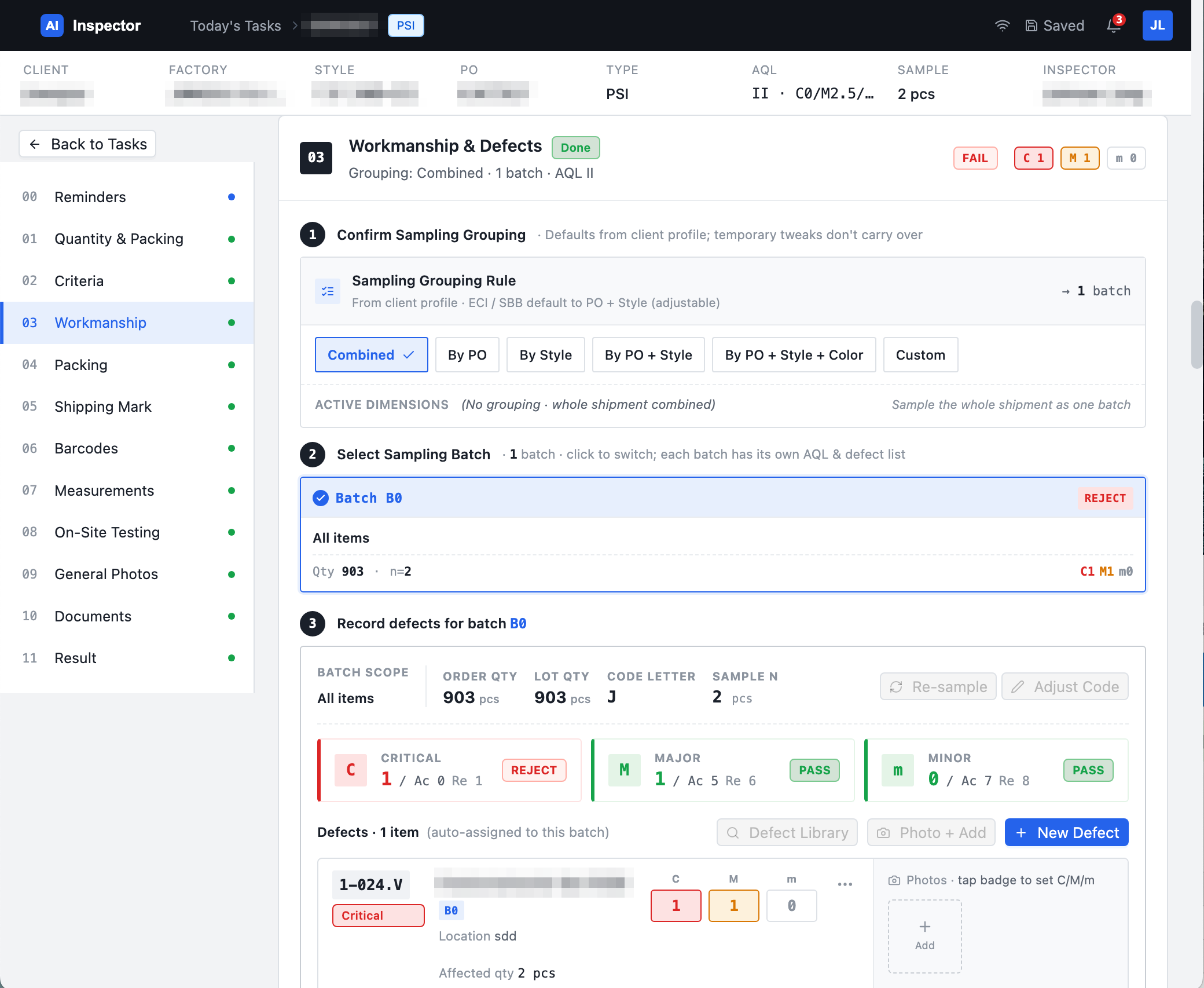
2. Report pre-review: identify differences, then let people decide
Reviewers need more than the report itself. They also consult general client standards, client-specific checking rules and materials for the individual inspection. The system organizes those inputs for comparison.
For example, a report may use a size designation that differs from the client’s size chart, or state “No logo” when approved artwork exists. A useful pre-review identifies the discrepancy, its supporting evidence and a suggested next step, so a reviewer can investigate it.
| Stage | What it checks | What follows |
|---|---|---|
| Text checks | Measurements, quantities, empty fields, references and logical consistency | An issue list with locations, evidence and suggested actions |
| Visual review | Photos, labels and approved artwork requiring image comparison | Further review based on task scope and available materials |
| Human handling | Whether an issue is valid and the relevant rule applies | Mark corrected, retained or false positive, with a handling record |
The code contains records for two review tiers, evidence fields and human handling states. A pre-review flag is not a final release decision. Performance on complex, multi-style and long reports still needs validation with suitable samples.
3. Business data assistance: from a question to a verifiable output
Business users can ask questions in Chinese, such as “How many inspection tasks does each supplier have, and what is the failure rate?”, then follow up with monthly trends or individual records.
Predefined query tools filter, group and calculate. Charts and exported tables use the structured query results; the model interprets the question and presents an explanation. Calculations, chart values and narrative interpretation have defined sources.
One demonstration in the materials returned 251 matching records, displayed the first 10, and exported the full matching result using the same conditions. The current code also imposes an export limit; users should be told the actual scope and limits that apply.
View the anonymized data-assistant demonstrations
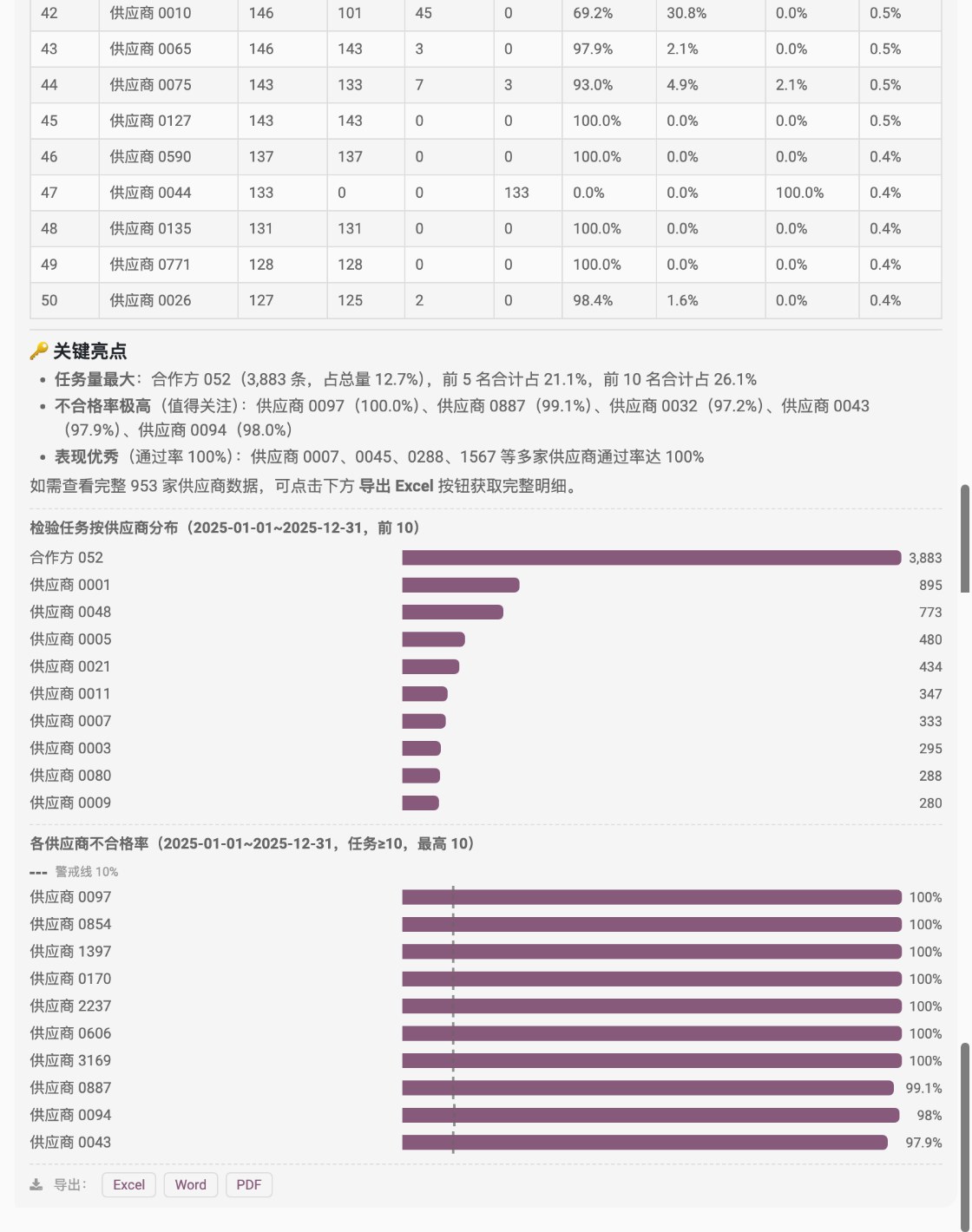
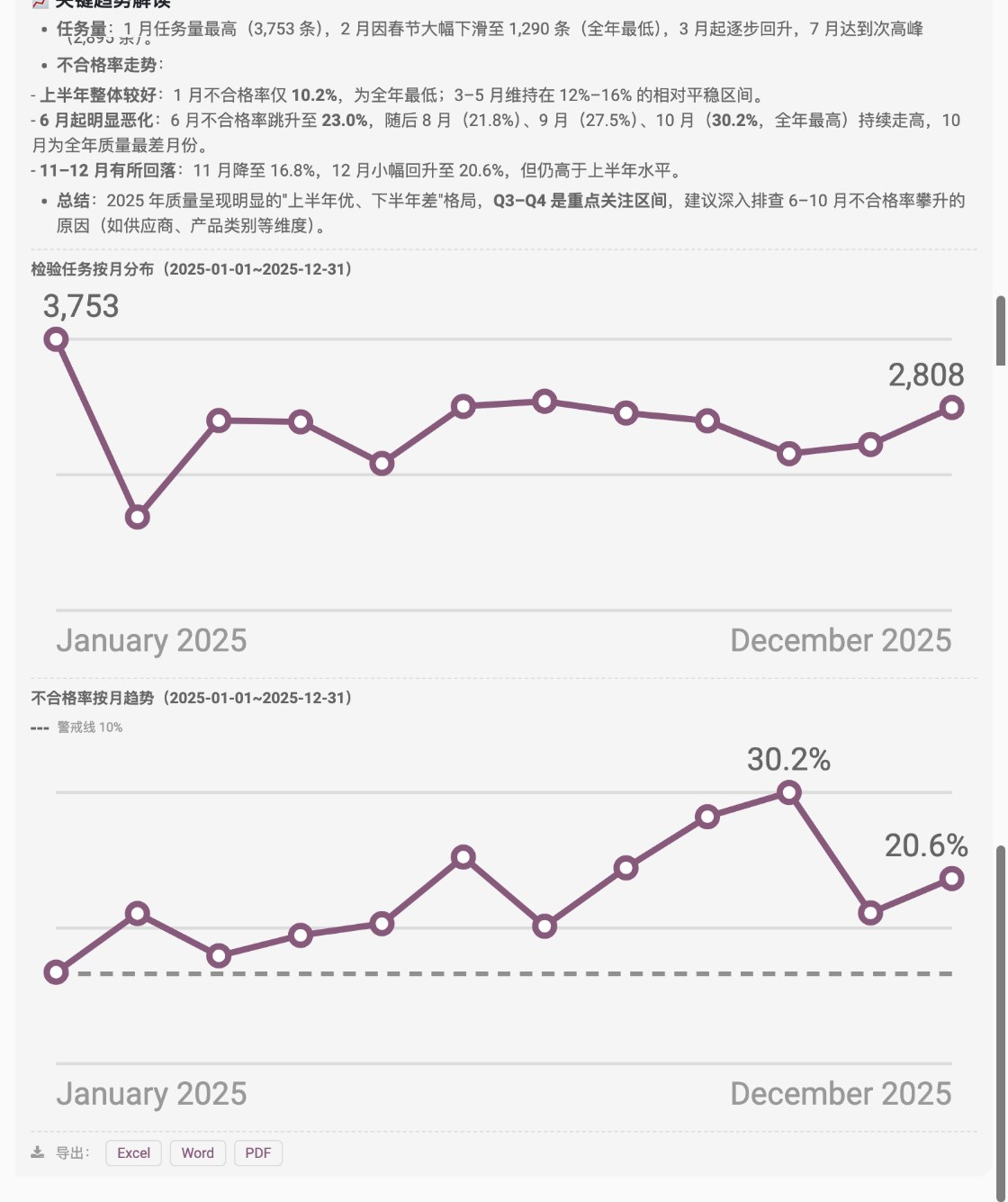
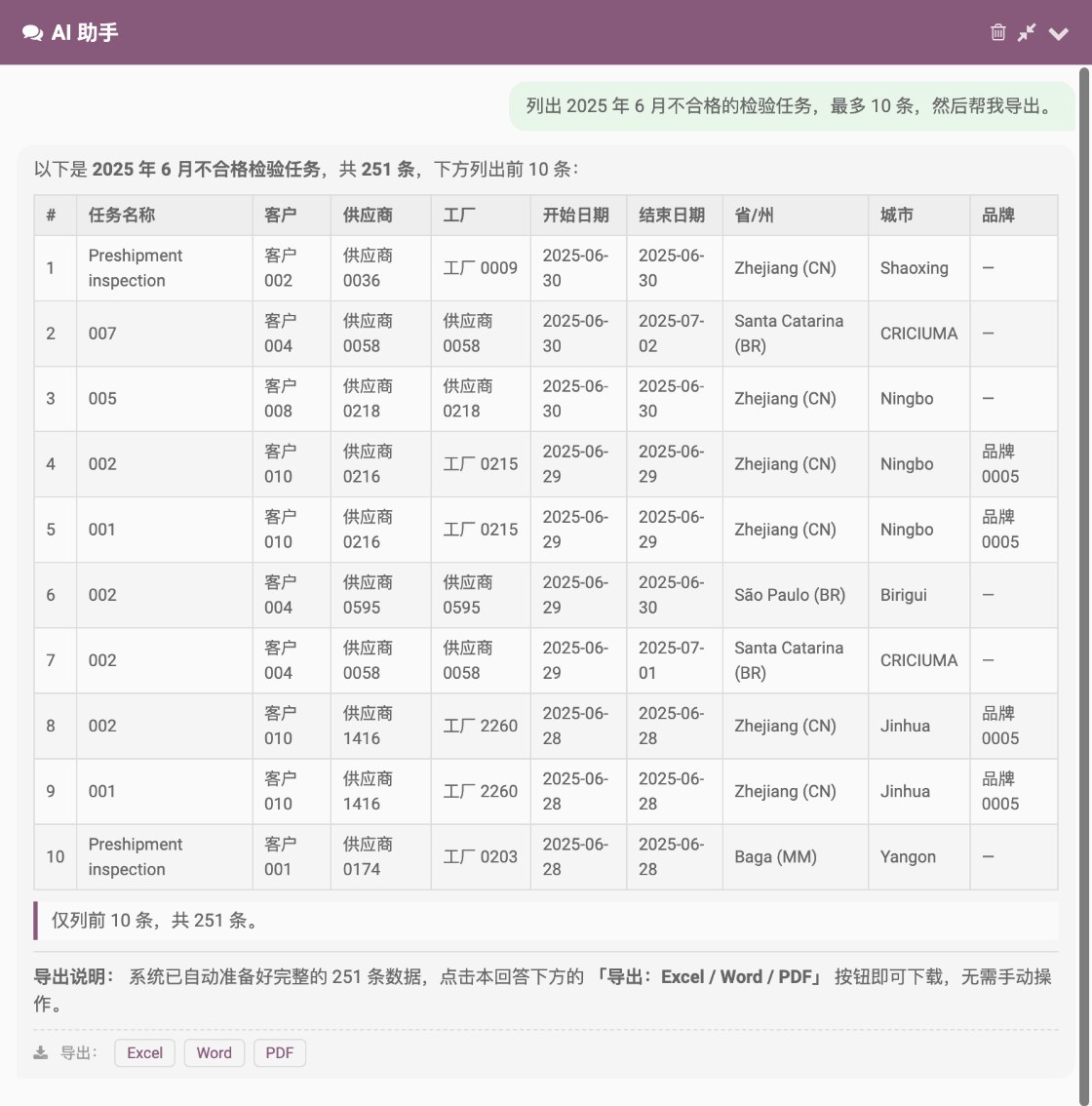
Keeping outputs tied to business facts
- User-specific data scope. The query flow retains user identity and client data filters. Export downloads check record ownership and a token.
- System-calculated numbers. Groupings, rates and totals come from tools. Charts and exported tables use structured results directly.
- Issues with evidence. Pre-review records include location, finding, expected result, evidence and a suggested action for human review.
- A record of processing and decisions. Review runs record the engine, prompt version, duration and usage. People can mark false positives and record reasons.
These are mechanisms identified in the source code. They do not constitute an independent security audit or complete acceptance test of the production environment.
What the available evidence supports
The following representative results come from the supplied materials, with their scope kept explicit.
| Capability | Reported result | Scope and evidence stage |
|---|---|---|
| Report generation | 55–110 minutes of manual work saved per report | Existing production records as reported in the materials; timing logs were not independently remeasured for this draft |
| Report pre-review | 8 of 8 human-baseline issues identified | Two real-report sample groups, with 5/5 and 3/3 matches. The materials also report zero false positives across three test rounds and seven additional issues confirmed by people. These results apply only to those samples |
| Data assistant | Three demonstration questions matched database checks | Supplier summaries, monthly summaries and task details; the database checks were not rerun for this draft |
The evidence stages for pre-review and the data assistant are respectively real-sample testing and system demonstrations with database comparisons. They do not establish that every capability has been fully rolled out in production. The materials also note that a complex multi-style report stress test had not fully met its targets.
Supplier scoring, predictive analysis, customer service automation and route optimization appear as proposals or plans in the source materials. Their estimated automation percentages are not presented here as achieved outcomes. Time saved is also not equated with net profit or net project return.
What ongoing support involves
Client standards, report templates, data definitions and system interfaces change. Further work needs to expand samples, review false positives, adjust rules, track duration and usage costs, and verify that changes preserve the existing workflow.
The reusable lesson is to organize the inputs and business rules first, connect generation, checks and queries to existing work, and retain professional judgment at the final decision points. Applying the approach in another industry requires a fresh assessment of materials, permissions, test samples and responsibilities.